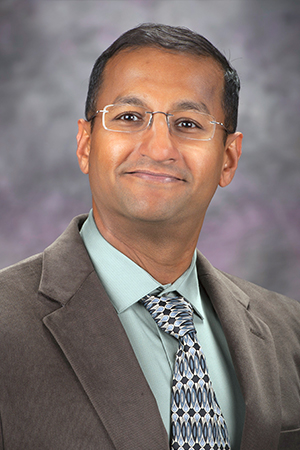
 Bala Natarajan
University Distinguished Professor
Clair N. Palmer and Sara M. Palmer Electrical Engineering Professorship
Contact information
3088 Engineering Hall
bala@k-state.edu
Personal website
Education
- Ph.D., Electrical Engineering, Colorado State University, 2002
- B.E., Electrical and Electronics Engineering, Birla Institute of Technology and Science, Pilani, India, 1997
- Ph.D., Statistics, Kansas State University, 2018
Professional experience
Bala Natarajan received his B.E (honors) degree in electrical and electronics engineering from Birla Institute of Technology and Science, Pilani, India, in 1997 and Ph.D. in Electrical Engineering from Colorado State University, Fort Collins, in 2002. In the fall of 2002, he joined the department of electrical and computer engineering at Kansas State University as an assistant professor. He was promoted to associate professor in 2008 and professor in 2013. He currently holds the Clair N. Palmer and Sara M. Palmer Electrical Engineering Professorship and is the director of the Cyber physical systems and Wireless Innovations (CPSWin) group. He received a second Ph.D. degree in theoretical statistics from Kansas State University in 2018. In his tenure at K-State, he has held multiple administrative positions within the department and across the university including serving as the interim director of International Research Development and Graduate Recruitment for the College of Engineering from 2014-15. In 2013, he served the State of Kansas as the sector lead for communications as part of the Critical Infrastructure Protection.
Research
Natarajan’s core scientific research expertise spans theoretical domains of statistical signal processing, stochastic and mathematical modeling, and optimization and networked control theories. Recently, his group has focused on advancing both theory and application of AI/ML techniques with special emphasis on active learning with limited data, uncertainty quantification, task-oriented optimal AI architecture design. The scope of his research is quite expansive and includes applications to wireless communications, sensor networks, cyber physical systems (e.g., smart grid), biomedical systems and complex network science.
Professor Natarajan and his group members have recently addressed a few long standing problems related to centralized and distributed networked estimation and control of large spatially distributed cyber physical systems (CPS). Applying these fundamental results in the context of a smart grid has led to many impactful algorithms. Additionally, Dr. Natarajan has also made impactful contributions to the area of cyber and disaster resilience of interconnected network of engineered CPS (e.g., interconnected energy, water and transportation networks). Specifically, he has developed an approach that involves deriving analytical approximations/bounds of network performance metrics and then systematically introducing spatio-temporal uncertainties to arrive at probabilistic measures of performance rather than resorting to extensive simulations of the underlying network (which is the typical approach). His contributions to the biomedical space include (1) developing novel signal processing methods to mitigate impact of motion artifacts in biomedical sensing modalities; (2) quantifying sleep quality in children with Autism spectrum disorder by detecting motion/restlessness based on data from a smart bed system; (3) developing hierarchical decision models for early detection of pancreatic and ovarian cancer using nanobiosensor data (with KU Medical Center); (4) graph neural network-based approaches for identifying biomarkers for traumatic brain injury (with University of Texas Medical Branch). He helped establish the Center of Excellence in Sports Science & Analytics (CESSA) at Indian Institute of Technology (IIT) Madras that focuses on athlete health, training and performance via IoT sensors and analytics.
Dr. Natarajan early work on carrier interferometry orthogonal frequency division multiplexing (OFDM) and discrete fourier transform (DFT) based coding in code division multiple access (CDMA) systems is part of the mobile technology standard - 3GPP Release 10 (and later releases) uplink specifications. His research group developed a new online trellis search based limited feedback polyphase precoding as well as spreading code design strategy that received widespread news coverage due to its potential for increasing capacity of wireless systems. Recently, Dr. Natarajan's group has introduced a new paradigm in semantic communication sytems based on integrating ideas from cognitive science - this approach based on the idea of "Conceptual spaces" has applications in AI/ML architectures as well. His group has also made significant contributions in the area of energy aware distributed detection and estimation in sensor networks. Specifically, a novel sensor deployment strategy based on optimal control theory principles was the first work to present a rigorous framework for sensor placement problems that were previously addressed based on heuristics. Other contributions in the sensor networks arena include understanding the fundamental limits of cooperative optimization, filtering in extremely energy constrained systems (e.g., networks with energy harvesting nodes), and identifying ways to manage power and rate resources to operate effectively.
Academic highlights
Highlights of Dr. Natarajan’s outstanding achievements include building a research group focused on cyber physical systems and wireless innovations (CPSWin) at K-State with consistent extramural support totaling about $40 million (as of 2026). A prolific scholar, he has published over 320 refereed journal and conference papers, a graduate-level book (Multi-carrier Technologies for Wireless Communications, Springer) and contributions to 4 other books, along with 3 patents. Equally impactful as a mentor, he has guided 60 graduate students (as of 2026, 34 Ph.D., and 26 M.S.) and 11 postdocs, many of whom have gone on to successful careers in top academic and industry positions worldwide. His international leadership is reflected in multiple Fulbright awards, which established enduring collaborations with top institutions in the world such as IIT Madras and strengthened graduate recruitment to K-State. He has received multiple best paper nominations and awards. Natarajan has served as and continuing to serve in the editorial board of top IEEE journals in the areas of wireless communications and cyber physical systems.